

Tip of the Month
October 2015
Using Extension Tubes with a Zoom Lens
Part II
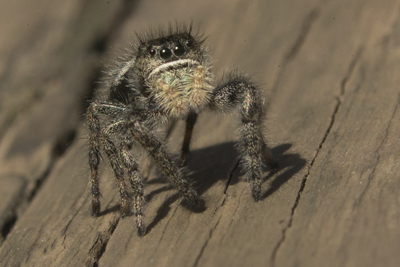
Jumping Spider at the Dragon's Mouth,
Yellowstone National Park
I certainly wouldn't expect to photograph many insects or spiders in Yellowstone in the last couple of weeks of September so I was very surprised to find this spider on a railing close to the parking lot. Actually, one of our Yellowstone participants, Glen, spotted the spider and showed it to me.
At any rate, I did not have a macro lens along but the spider was fairly large for a jumping spider and the spider seemed very cooperative. As it turned out, the spider was like few I've ever seen. Instead of running off or slipping into a crevice or hole, this spider would run down the railing right to the camera! I can't figure out why -- whether it was seeking my shade (available elsewhere, too) or it was curious, or aggressive -- I just don't know.
Without a macro lens I had to improvise, using the best lens I had for the job at the time. For this shot I used my 100-400mm zoom, with a 25mm extension tube and a 1.4X tele-converter. I put the 25mm extension tube right behind the 100-400mm lens, then placed the 1.4X tele-converter behind this system (ie the tele-converter was attached to the camera).
Now here's the trick. One would think that zooming to 400mm would give me the biggest image size, rather than zooming down to 100mm, but that's not true. If you refer to my last Tip (Using Extension Tubes with a Zoom Lens) you'll see the math (easy stuff) involved, but to sum up, with a 25mm tube attached to a 400mm I have a 1:16X reproduction ratio, but attached to a lens zoomed to 100mm the reproduction ratio is 1:4X. This allows me to focus closer, getting that bigger image size, than I'd be able to do so with a 400mm.
Adding the 1.4X tele-converter, multiplying that 1:4X ratio by the 1.4X magnification, I was nearly 1:2, or half life-size. I still had to crop the image to get the image size you see here, but there's an advantage here, too.
You probably know that as Image Size Increases, Depth of Field Decreases. So the closer you get to a subject, regardless of the lens in use, the shallower the depth of field becomes. This means that a frame-filling spider, shot at 1:1 or life-size, will have less in focus, or sharpness, than the same spider shot at 1:4. Of course, the 1:4 image will result in a smaller image size for the spider, but more will be in focus. However, if your camera will sustain a good crop and still yield detail, you can crop the image, get a big image as a result, and have the best possible depth of field!
Check out the last Tip Using Extension Tubes with a Zoom Lens if you're not clear on this, or take our Complete Digital Nature Photo Course, or our Advanced Course, and get hand's on instruction on this tip and many more.
Using Extension Tubes with a Zoom Lens
Converting RAW to Black and White
Nature Photography Magazine
Photographing Lightning
Bataflae Photo Backpack
The Guide to Tropical Nature Photography
Essential Gear for Safaris
Take our Digital Nature Photo Course FIRST!
GPS and Home Security
Range IR Camera Remote
Gitzo Monopod 5561T Monopod
Easy Macro with Extension Tubes and Zoom Lenses
FotoSharp Camou Rain Covers
Canon 17mm T/S Lens
Locking Button for the Canon 7D
NIK HDR Program
Silver Efex Pro for Black and White Images
Beware the DELL Software Solution Rip Off
How and What We Pack for Trips
Canon Digital Learning Center
The Movie Mode with the Canon Mark IV
Batch Renaming in Bridge and CS5
Alternate Uses of some Bogen Products
Hoodman Products
Using High ISO and Live View for Focusing in Dim Light
Art Print Scams for Hungry Photographers
Hungry Vultures ruin vehicles in the Everglades
Use a Short Lens for Depth of Field
Get Professional Help!
Mini-Molar Bag
Access America Trip Insurance
Bogen Base for Macro Work
Archived Tips of the Month
prior to July 2009
Most of my original Tips of the Month for the last several
years are available through this link. Warning - some of the links are broken, so some are not available at this time. Also, the 'look' is from my
original web site, although if I ever have enough time I might redo these pages to match the new web site But that's not a high priority.
Join us on Facebook at: Follow Hoot Hollow


Previous Tips, July 2009 onward
Check out our latest website,
mcdonaldwildlifephotos.com
where we'll be adding portfolios and eventually building up
a searchable data base for photo buyers. We've just started,
and the selection is limited, but it is still worth a visit!
Office Phone: (717) 543-6423
Or FAX us at: (717) 543-5342
Check out our latest website,
mcdonaldwildlifephotos.com
where we'll be constantly adding new portfolios!
Office Phone: (717) 543-6423
Or FAX us at: (717) 543-5342

Tip of the Month
October 2015
Using Extension Tubes with a Zoom Lens
Part II
Jumping Spider at the Dragon's Mouth,
Yellowstone National Park
I certainly wouldn't expect to photograph many insects or spiders in Yellowstone in the last couple of weeks of September so I was very surprised to find this spider on a railing close to the parking lot. Actually, one of our Yellowstone participants, Glen, spotted the spider and showed it to me.
At any rate, I did not have a macro lens along but the spider was fairly large for a jumping spider and the spider seemed very cooperative. As it turned out, the spider was like few I've ever seen. Instead of running off or slipping into a crevice or hole, this spider would run down the railing right to the camera! I can't figure out why -- whether it was seeking my shade (available elsewhere, too) or it was curious, or aggressive -- I just don't know.
Without a macro lens I had to improvise, using the best lens I had for the job at the time. For this shot I used my 100-400mm zoom, with a 25mm extension tube and a 1.4X tele-converter. I put the 25mm extension tube right behind the 100-400mm lens, then placed the 1.4X tele-converter behind this system (ie the tele-converter was attached to the camera).
Now here's the trick. One would think that zooming to 400mm would give me the biggest image size, rather than zooming down to 100mm, but that's not true. If you refer to my last Tip (Using Extension Tubes with a Zoom Lens) you'll see the math (easy stuff) involved, but to sum up, with a 25mm tube attached to a 400mm I have a 1:16X reproduction ratio, but attached to a lens zoomed to 100mm the reproduction ratio is 1:4X. This allows me to focus closer, getting that bigger image size, than I'd be able to do so with a 400mm.
Adding the 1.4X tele-converter, multiplying that 1:4X ratio by the 1.4X magnification, I was nearly 1:2, or half life-size. I still had to crop the image to get the image size you see here, but there's an advantage here, too.
You probably know that as Image Size Increases, Depth of Field Decreases. So the closer you get to a subject, regardless of the lens in use, the shallower the depth of field becomes. This means that a frame-filling spider, shot at 1:1 or life-size, will have less in focus, or sharpness, than the same spider shot at 1:4. Of course, the 1:4 image will result in a smaller image size for the spider, but more will be in focus. However, if your camera will sustain a good crop and still yield detail, you can crop the image, get a big image as a result, and have the best possible depth of field!
Check out the last Tip Using Extension Tubes with a Zoom Lens if you're not clear on this, or take our Complete Digital Nature Photo Course, or our Advanced Course, and get hand's on instruction on this tip and many more.
Using Extension Tubes with a Zoom Lens
Converting RAW to Black and White
Nature Photography Magazine
Photographing Lightning
Bataflae Photo Backpack
The Guide to Tropical Nature Photography
Essential Gear for Safaris
Take our Digital Nature Photo Course FIRST!
GPS and Home Security
Range IR Camera Remote
Gitzo Monopod 5561T Monopod
Easy Macro with Extension Tubes and Zoom Lenses
FotoSharp Camou Rain Covers
Canon 17mm T/S Lens
Locking Button for the Canon 7D
NIK HDR Program
Silver Efex Pro for Black and White Images
Beware the DELL Software Solution Rip Off
How and What We Pack for Trips
Canon Digital Learning Center
The Movie Mode with the Canon Mark IV
Batch Renaming in Bridge and CS5
Alternate Uses of some Bogen Products
Hoodman Products
Using High ISO and Live View for Focusing in Dim Light
Art Print Scams for Hungry Photographers
Hungry Vultures ruin vehicles in the Everglades
Use a Short Lens for Depth of Field
Get Professional Help!
Mini-Molar Bag
Access America Trip Insurance
Bogen Base for Macro Work
Archived Tips of the Month
prior to July 2009
Most of my original Tips of the Month for the last several
years are available through this link. Warning - some of the links are broken, so some are not available at this time. Also, the 'look' is from my
original web site, although if I ever have enough time I might redo these pages to match the new web site But that's not a high priority.
Join us on Facebook at: Follow Hoot Hollow
Previous Tips, July 2009 onward
Check out our latest website,
mcdonaldwildlifephotos.com
where we'll be adding portfolios and eventually building up
a searchable data base for photo buyers. We've just started,
and the selection is limited, but it is still worth a visit!
Office Phone: (717) 543-6423
Or FAX us at: (717) 543-5342
Check out our latest website,
mcdonaldwildlifephotos.com
where we'll be constantly adding new portfolios!
Office Phone: (717) 543-6423
Or FAX us at: (717) 543-5342
Tip of the Month
October 2015
Using Extension Tubes with a Zoom Lens
Part II
Jumping Spider at the Dragon's Mouth,
Yellowstone National Park
I certainly wouldn't expect to photograph many insects or spiders in Yellowstone in the last couple of weeks of September so I was very surprised to find this spider on a railing close to the parking lot. Actually, one of our Yellowstone participants, Glen, spotted the spider and showed it to me.
At any rate, I did not have a macro lens along but the spider was fairly large for a jumping spider and the spider seemed very cooperative. As it turned out, the spider was like few I've ever seen. Instead of running off or slipping into a crevice or hole, this spider would run down the railing right to the camera! I can't figure out why -- whether it was seeking my shade (available elsewhere, too) or it was curious, or aggressive -- I just don't know.
Without a macro lens I had to improvise, using the best lens I had for the job at the time. For this shot I used my 100-400mm zoom, with a 25mm extension tube and a 1.4X tele-converter. I put the 25mm extension tube right behind the 100-400mm lens, then placed the 1.4X tele-converter behind this system (ie the tele-converter was attached to the camera).
Now here's the trick. One would think that zooming to 400mm would give me the biggest image size, rather than zooming down to 100mm, but that's not true. If you refer to my last Tip (Using Extension Tubes with a Zoom Lens) you'll see the math (easy stuff) involved, but to sum up, with a 25mm tube attached to a 400mm I have a 1:16X reproduction ratio, but attached to a lens zoomed to 100mm the reproduction ratio is 1:4X. This allows me to focus closer, getting that bigger image size, than I'd be able to do so with a 400mm.
Adding the 1.4X tele-converter, multiplying that 1:4X ratio by the 1.4X magnification, I was nearly 1:2, or half life-size. I still had to crop the image to get the image size you see here, but there's an advantage here, too.
You probably know that as Image Size Increases, Depth of Field Decreases. So the closer you get to a subject, regardless of the lens in use, the shallower the depth of field becomes. This means that a frame-filling spider, shot at 1:1 or life-size, will have less in focus, or sharpness, than the same spider shot at 1:4. Of course, the 1:4 image will result in a smaller image size for the spider, but more will be in focus. However, if your camera will sustain a good crop and still yield detail, you can crop the image, get a big image as a result, and have the best possible depth of field!
Check out the last Tip Using Extension Tubes with a Zoom Lens if you're not clear on this, or take our Complete Digital Nature Photo Course, or our Advanced Course, and get hand's on instruction on this tip and many more.
Using Extension Tubes with a Zoom Lens
Converting RAW to Black and White
Nature Photography Magazine
Photographing Lightning
Bataflae Photo Backpack
The Guide to Tropical Nature Photography
Essential Gear for Safaris
Take our Digital Nature Photo Course FIRST!
GPS and Home Security
Range IR Camera Remote
Gitzo Monopod 5561T Monopod
Easy Macro with Extension Tubes and Zoom Lenses
FotoSharp Camou Rain Covers
Canon 17mm T/S Lens
Locking Button for the Canon 7D
NIK HDR Program
Silver Efex Pro for Black and White Images
Beware the DELL Software Solution Rip Off
How and What We Pack for Trips
Canon Digital Learning Center
The Movie Mode with the Canon Mark IV
Batch Renaming in Bridge and CS5
Alternate Uses of some Bogen Products
Hoodman Products
Using High ISO and Live View for Focusing in Dim Light
Art Print Scams for Hungry Photographers
Hungry Vultures ruin vehicles in the Everglades
Use a Short Lens for Depth of Field
Get Professional Help!
Mini-Molar Bag
Access America Trip Insurance
Bogen Base for Macro Work
Archived Tips of the Month
prior to July 2009
Most of my original Tips of the Month for the last several
years are available through this link. Warning - some of the links are broken, so some are not available at this time. Also, the 'look' is from my
original web site, although if I ever have enough time I might redo these pages to match the new web site But that's not a high priority.
Join us on Facebook at: Follow Hoot Hollow
Previous Tips, July 2009 onward
Check out our latest website,
mcdonaldwildlifephotos.com
where we'll be adding portfolios and eventually building up
a searchable data base for photo buyers. We've just started,
and the selection is limited, but it is still worth a visit!
Office Phone: (717) 543-6423
Or FAX us at: (717) 543-5342
Check out our latest website,
mcdonaldwildlifephotos.com
where we'll be constantly adding new portfolios!
Office Phone: (717) 543-6423
Or FAX us at: (717) 543-5342
Tip of the Month
October 2015
Using Extension Tubes with a Zoom Lens
Part II
Jumping Spider at the Dragon's Mouth,
Yellowstone National Park
I certainly wouldn't expect to photograph many insects or spiders in Yellowstone in the last couple of weeks of September so I was very surprised to find this spider on a railing close to the parking lot. Actually, one of our Yellowstone participants, Glen, spotted the spider and showed it to me.
At any rate, I did not have a macro lens along but the spider was fairly large for a jumping spider and the spider seemed very cooperative. As it turned out, the spider was like few I've ever seen. Instead of running off or slipping into a crevice or hole, this spider would run down the railing right to the camera! I can't figure out why -- whether it was seeking my shade (available elsewhere, too) or it was curious, or aggressive -- I just don't know.
Without a macro lens I had to improvise, using the best lens I had for the job at the time. For this shot I used my 100-400mm zoom, with a 25mm extension tube and a 1.4X tele-converter. I put the 25mm extension tube right behind the 100-400mm lens, then placed the 1.4X tele-converter behind this system (ie the tele-converter was attached to the camera).
Now here's the trick. One would think that zooming to 400mm would give me the biggest image size, rather than zooming down to 100mm, but that's not true. If you refer to my last Tip (Using Extension Tubes with a Zoom Lens) you'll see the math (easy stuff) involved, but to sum up, with a 25mm tube attached to a 400mm I have a 1:16X reproduction ratio, but attached to a lens zoomed to 100mm the reproduction ratio is 1:4X. This allows me to focus closer, getting that bigger image size, than I'd be able to do so with a 400mm.
Adding the 1.4X tele-converter, multiplying that 1:4X ratio by the 1.4X magnification, I was nearly 1:2, or half life-size. I still had to crop the image to get the image size you see here, but there's an advantage here, too.
You probably know that as Image Size Increases, Depth of Field Decreases. So the closer you get to a subject, regardless of the lens in use, the shallower the depth of field becomes. This means that a frame-filling spider, shot at 1:1 or life-size, will have less in focus, or sharpness, than the same spider shot at 1:4. Of course, the 1:4 image will result in a smaller image size for the spider, but more will be in focus. However, if your camera will sustain a good crop and still yield detail, you can crop the image, get a big image as a result, and have the best possible depth of field!
Check out the last Tip Using Extension Tubes with a Zoom Lens if you're not clear on this, or take our Complete Digital Nature Photo Course, or our Advanced Course, and get hand's on instruction on this tip and many more.
Using Extension Tubes with a Zoom Lens
Converting RAW to Black and White
Nature Photography Magazine
Photographing Lightning
Bataflae Photo Backpack
The Guide to Tropical Nature Photography
Essential Gear for Safaris
Take our Digital Nature Photo Course FIRST!
GPS and Home Security
Range IR Camera Remote
Gitzo Monopod 5561T Monopod
Easy Macro with Extension Tubes and Zoom Lenses
FotoSharp Camou Rain Covers
Canon 17mm T/S Lens
Locking Button for the Canon 7D
NIK HDR Program
Silver Efex Pro for Black and White Images
Beware the DELL Software Solution Rip Off
How and What We Pack for Trips
Canon Digital Learning Center
The Movie Mode with the Canon Mark IV
Batch Renaming in Bridge and CS5
Alternate Uses of some Bogen Products
Hoodman Products
Using High ISO and Live View for Focusing in Dim Light
Art Print Scams for Hungry Photographers
Hungry Vultures ruin vehicles in the Everglades
Use a Short Lens for Depth of Field
Get Professional Help!
Mini-Molar Bag
Access America Trip Insurance
Bogen Base for Macro Work
Archived Tips of the Month
prior to July 2009
Most of my original Tips of the Month for the last several
years are available through this link. Warning - some of the links are broken, so some are not available at this time. Also, the 'look' is from my
original web site, although if I ever have enough time I might redo these pages to match the new web site But that's not a high priority.
Join us on Facebook at: Follow Hoot Hollow
Previous Tips, July 2009 onward
Check out our latest website,
mcdonaldwildlifephotos.com
where we'll be adding portfolios and eventually building up
a searchable data base for photo buyers. We've just started,
and the selection is limited, but it is still worth a visit!
Office Phone: (717) 543-6423
Or FAX us at: (717) 543-5342
Tip of the Month
October 2015
Using Extension Tubes with a Zoom Lens
Part II
Jumping Spider at the Dragon's Mouth,
Yellowstone National Park
I certainly wouldn't expect to photograph many insects or spiders in Yellowstone in the last couple of weeks of September so I was very surprised to find this spider on a railing close to the parking lot. Actually, one of our Yellowstone participants, Glen, spotted the spider and showed it to me.
At any rate, I did not have a macro lens along but the spider was fairly large for a jumping spider and the spider seemed very cooperative. As it turned out, the spider was like few I've ever seen. Instead of running off or slipping into a crevice or hole, this spider would run down the railing right to the camera! I can't figure out why -- whether it was seeking my shade (available elsewhere, too) or it was curious, or aggressive -- I just don't know.
Without a macro lens I had to improvise, using the best lens I had for the job at the time. For this shot I used my 100-400mm zoom, with a 25mm extension tube and a 1.4X tele-converter. I put the 25mm extension tube right behind the 100-400mm lens, then placed the 1.4X tele-converter behind this system (ie the tele-converter was attached to the camera).
Now here's the trick. One would think that zooming to 400mm would give me the biggest image size, rather than zooming down to 100mm, but that's not true. If you refer to my last Tip (Using Extension Tubes with a Zoom Lens) you'll see the math (easy stuff) involved, but to sum up, with a 25mm tube attached to a 400mm I have a 1:16X reproduction ratio, but attached to a lens zoomed to 100mm the reproduction ratio is 1:4X. This allows me to focus closer, getting that bigger image size, than I'd be able to do so with a 400mm.
Adding the 1.4X tele-converter, multiplying that 1:4X ratio by the 1.4X magnification, I was nearly 1:2, or half life-size. I still had to crop the image to get the image size you see here, but there's an advantage here, too.
You probably know that as Image Size Increases, Depth of Field Decreases. So the closer you get to a subject, regardless of the lens in use, the shallower the depth of field becomes. This means that a frame-filling spider, shot at 1:1 or life-size, will have less in focus, or sharpness, than the same spider shot at 1:4. Of course, the 1:4 image will result in a smaller image size for the spider, but more will be in focus. However, if your camera will sustain a good crop and still yield detail, you can crop the image, get a big image as a result, and have the best possible depth of field!
Check out the last Tip Using Extension Tubes with a Zoom Lens if you're not clear on this, or take our Complete Digital Nature Photo Course, or our Advanced Course, and get hand's on instruction on this tip and many more.
Using Extension Tubes with a Zoom Lens
Converting RAW to Black and White
Nature Photography Magazine
Photographing Lightning
Bataflae Photo Backpack
The Guide to Tropical Nature Photography
Essential Gear for Safaris
Take our Digital Nature Photo Course FIRST!
GPS and Home Security
Range IR Camera Remote
Gitzo Monopod 5561T Monopod
Easy Macro with Extension Tubes and Zoom Lenses
FotoSharp Camou Rain Covers
Canon 17mm T/S Lens
Locking Button for the Canon 7D
NIK HDR Program
Silver Efex Pro for Black and White Images
Beware the DELL Software Solution Rip Off
How and What We Pack for Trips
Canon Digital Learning Center
The Movie Mode with the Canon Mark IV
Batch Renaming in Bridge and CS5
Alternate Uses of some Bogen Products
Hoodman Products
Using High ISO and Live View for Focusing in Dim Light
Art Print Scams for Hungry Photographers
Hungry Vultures ruin vehicles in the Everglades
Use a Short Lens for Depth of Field
Get Professional Help!
Mini-Molar Bag
Access America Trip Insurance
Bogen Base for Macro Work
Archived Tips of the Month
prior to July 2009
Most of my original Tips of the Month for the last several
years are available through this link. Warning - some of the links are broken, so some are not available at this time. Also, the 'look' is from my
original web site, although if I ever have enough time I might redo these pages to match the new web site But that's not a high priority.
Join us on Facebook at: Follow Hoot Hollow
Previous Tips, July 2009 onward
Check out our latest website,
mcdonaldwildlifephotos.com
where we'll be adding portfolios and eventually building up
a searchable data base for photo buyers. We've just started,
and the selection is limited, but it is still worth a visit!
Office Phone: (717) 543-6423
Or FAX us at: (717) 543-5342
I certainly wouldn't expect to photograph many insects or spiders in Yellowstone in the last couple of weeks of September so I was very surprised to find this spider on a railing close to the parking lot. Actually, one of our Yellowstone participants, Glen, spotted the spider and showed it to me.
At any rate, I did not have a macro lens along but the spider was fairly large for a jumping spider and the spider seemed very cooperative. As it turned out, the spider was like few I've ever seen. Instead of running off or slipping into a crevice or hole, this spider would run down the railing right to the camera! I can't figure out why -- whether it was seeking my shade (available elsewhere, too) or it was curious, or aggressive -- I just don't know.
Without a macro lens I had to improvise, using the best lens I had for the job at the time. For this shot I used my 100-400mm zoom, with a 25mm extension tube and a 1.4X tele-converter. I put the 25mm extension tube right behind the 100-400mm lens, then placed the 1.4X tele-converter behind this system (ie the tele-converter was attached to the camera).
Now here's the trick. One would think that zooming to 400mm would give me the biggest image size, rather than zooming down to 100mm, but that's not true. If you refer to my last Tip (Using Extension Tubes with a Zoom Lens) you'll see the math (easy stuff) involved, but to sum up, with a 25mm tube attached to a 400mm I have a 1:16X reproduction ratio, but attached to a lens zoomed to 100mm the reproduction ratio is 1:4X. This allows me to focus closer, getting that bigger image size, than I'd be able to do so with a 400mm.
Adding the 1.4X tele-converter, multiplying that 1:4X ratio by the 1.4X magnification, I was nearly 1:2, or half life-size. I still had to crop the image to get the image size you see here, but there's an advantage here, too.
You probably know that as Image Size Increases, Depth of Field Decreases. So the closer you get to a subject, regardless of the lens in use, the shallower the depth of field becomes. This means that a frame-filling spider, shot at 1:1 or life-size, will have less in focus, or sharpness, than the same spider shot at 1:4. Of course, the 1:4 image will result in a smaller image size for the spider, but more will be in focus. However, if your camera will sustain a good crop and still yield detail, you can crop the image, get a big image as a result, and have the best possible depth of field!
Check out the last Tip Using Extension Tubes with a Zoom Lens if you're not clear on this, or take our Complete Digital Nature Photo Course, or our Advanced Course, and get hand's on instruction on this tip and many more.
Using Extension Tubes with a Zoom Lens
Converting RAW to Black and White
Nature Photography Magazine
Photographing Lightning
Bataflae Photo Backpack
The Guide to Tropical Nature Photography
Essential Gear for Safaris
Take our Digital Nature Photo Course FIRST!
GPS and Home Security
Range IR Camera Remote
Gitzo Monopod 5561T Monopod
Easy Macro with Extension Tubes and Zoom Lenses
FotoSharp Camou Rain Covers
Canon 17mm T/S Lens
Locking Button for the Canon 7D
NIK HDR Program
Silver Efex Pro for Black and White Images
Beware the DELL Software Solution Rip Off
How and What We Pack for Trips
Canon Digital Learning Center
The Movie Mode with the Canon Mark IV
Batch Renaming in Bridge and CS5
Alternate Uses of some Bogen Products
Hoodman Products
Using High ISO and Live View for Focusing in Dim Light
Art Print Scams for Hungry Photographers
Hungry Vultures ruin vehicles in the Everglades
Use a Short Lens for Depth of Field
Get Professional Help!
Mini-Molar Bag
Access America Trip Insurance
Bogen Base for Macro Work
Archived Tips of the Month
prior to July 2009
Most of my original Tips of the Month for the last several
years are available through this link. Warning - some of the links are broken, so some are not available at this time. Also, the 'look' is from my
original web site, although if I ever have enough time I might redo these pages to match the new web site But that's not a high priority.
Join us on Facebook at: Follow Hoot Hollow
Previous Tips, July 2009 onward
|
|
|
|
||
|
|
|
|
||
Previous Tips, July 2009 onward
Check out our latest website,
mcdonaldwildlifephotos.com
where we'll be adding portfolios and eventually building up
a searchable data base for photo buyers. We've just started,
and the selection is limited, but it is still worth a visit!
Office Phone: (717) 543-6423
Or FAX us at: (717) 543-5342
Check out our latest website,
mcdonaldwildlifephotos.com
where we'll be constantly adding new portfolios!
Check out our latest website,
mcdonaldwildlifephotos.com
where we'll be constantly adding new portfolios!
Office Phone: (717) 543-6423
Or FAX us at: (717) 543-5342
New Feature: |
Mountain Lion What do they look like? | Immediate Openings | New Trips and Future Offerings |
Tip of the Month |
|||